
Resonant Research Council
The Future of Science is Relational
How do we come to know? And what does the way we know make perceptible?
The challenges we face have outgrown the ways of knowing our institutions consistently support. Scientists are being asked to understand living systems of extraordinary complexity, and we can only understand and respond to what we are able to perceive.
Modern science has generated remarkable insight and technical power. Many of its dominant methods have also depended on forms of separation: observer from observed, mind from matter, human from the living world. These methods perceive some dimensions of reality with great precision. They also shape what becomes perceptible, and what stays outside the frame.
Indigenous knowledge systems have long held and practiced relational ways of knowing, grounded in participation, reciprocity, and sustained relationship with the living world. These are refined traditions of knowledge and practice, carried across generations. Increasingly, fields across contemporary science are also describing a world constituted through relationship and interdependence.
Life is relational. Ways of knowing shaped by separation make only part of that relational reality perceptible. As coherence deepens, within ourselves, with one another, and in relationship with the living world, more of what is present becomes perceptible.
Our research follows what changes in how we come to know, and in what can be known, when the conditions of knowing themselves become part of the inquiry.
This inquiry is anchored by the Resonant Research Council, bringing scientists, thought leaders, and Indigenous Elders into sustained relationship with one another. It is carried into practice through the Center for Applied Coherence, where relational ways of being and knowing are cultivated within organizations, bioregional initiatives, and wider fields of collaboration.
Coherence Is a Way of Knowing
How we relate shapes what we can know.
Coherence is the alignment of heart, body, and mind, expressed within and through relationship. Within a person. Between people. Between the knower and the living world.
When relationship is coherent, perception changes. What becomes visible expands.
Multiple scientific fields are arriving at this recognition independently, from different directions, with converging evidence.
Traditions across time have called coherence by another name: love. Love as the organizing principle of life.
Love is not merely an inspiration for inquiry. It is a condition for it.
When we fragment attention and sever relationship, we lose access.
Coherence opens that access.
This is epistemological transformation. Reweaving the roots of how we come to know.
The Inquiry
Based on Kauaʻi, Hawaiʻi, Coherence Lab has spent more than a decade asking a simple but radical question:
What becomes possible when coherence is the foundation?
In deep collaboration with Indigenous Knowledge Holders from the Pacific, the Americas, Africa, and beyond, and drawing from contemplative science, relational epistemology, and transdisciplinary inquiry, we cultivate conditions for coherence within communities, across cultures, and in spaces where science, policy, and ceremony meet.
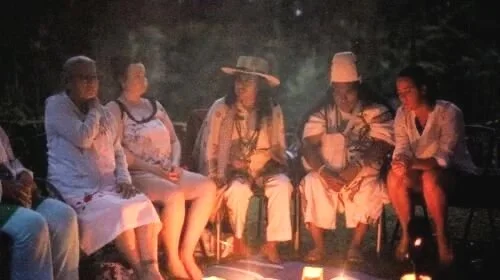
Since February 2023, this has included synchronized New Moon ceremonies held across time zones and traditions. These are disciplined practices for cultivating shared relational alignment, sustained through integration circles, place-based immersions on Kauaʻi, and ongoing dialogue. Elders gather alongside scientists, thought leaders, and artists, including contributors to the IPCC and IPBES.
This is research conducted from within coherence. Participating scientists report shifts in how they frame questions, what they are able to perceive, and how collaboration unfolds within complex systems.
This living Community of Practice gave rise to the Resonant Research Council, a global community of scientists, thought leaders, Indigenous Elders, and practitioners co-creating a new model of inquiry. Together, we are developing a multi-year research initiative that explores:
Coherence and love as conditions of knowing, capacities that can be studied, practiced, and taught
Ceremony, guided by Indigenous Elders, as a way of knowing in its own right
Living fields: research environments designed to cultivate coherence
New frontiers of perception, what becomes perceptible when the knower is in coherent relationship with the living world.
This work is already underway.
→ Coherence, Relationship, and the Future of Science (Horn, P. & Wrathall, D., 2026).
Available upon request. Contact prajna@coherencelab.org.